

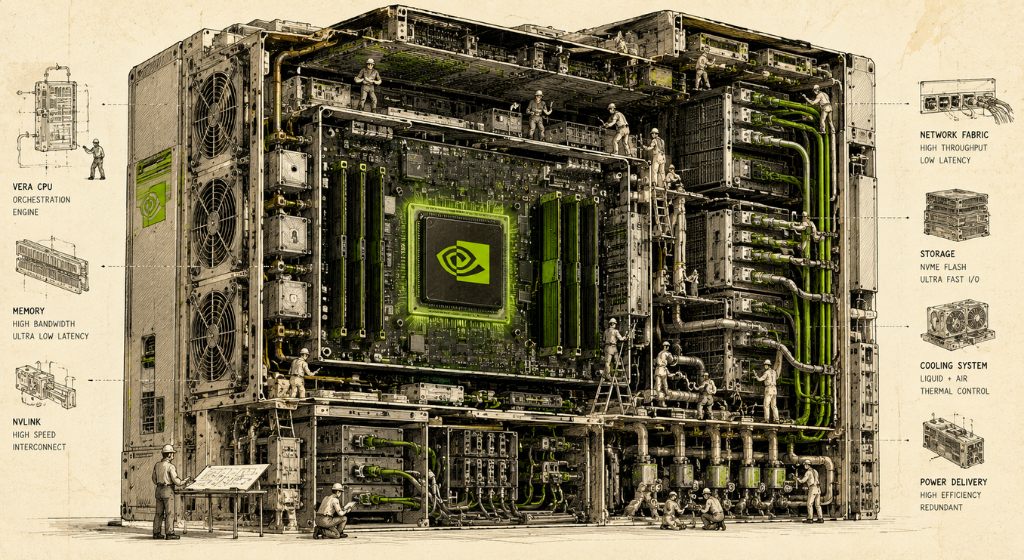
As AI computing reaches enormous scale, Nvidia’s competitive advantage is shifting from simply producing powerful GPUs toward integrating the memory, storage, networking and orchestration systems required to keep those processors operating efficiently. (Source: Image by RR)
Nvidia’s Competitive Moat Broadens as AI Systems Grow More Complex
Nvidia’s competitive advantage in artificial intelligence is increasingly extending beyond the GPUs that made it the dominant supplier of AI computing hardware. As Amazon, Google and other hyperscalers develop custom accelerators, investors have questioned whether competition could erode Nvidia’s extraordinary position in AI chips. But the emergence of enormous gigawatt-scale computing clusters is creating another challenge: efficiently coordinating the memory, storage, networking and data movement surrounding those processors. Nvidia increasingly sells specialized hardware addressing those problems as part of an integrated computing system.
The company’s new Vera Rubin architecture illustrates the strategy. Rather than simply pairing customers with its latest Rubin GPUs, Nvidia is building an ecosystem that includes Vera CPUs alongside specialized inference, storage and networking hardware. These components focus less on performing AI calculations themselves and more on ensuring that information reaches GPUs quickly enough to keep expensive computing resources operating efficiently. Nvidia, as noted in an article at techcrunch.com, says its Vera CPU can significantly accelerate some data-management operations, reducing bottlenecks and allowing storage systems to deliver more of their available performance.
The underlying challenge is becoming increasingly important as AI companies pursue lower costs and better tokens-per-watt efficiency. Simply adding more processors cannot solve every performance problem if those chips spend time waiting for data. OpenAI’s Jalapeño architecture reflects a different response to the same issue, attempting to minimize data movement by keeping more of a workload within one highly integrated system. Both strategies demonstrate that the next frontier of AI hardware competition is shifting from raw processor performance toward optimizing how entire computing environments operate.
That transition could strengthen Nvidia’s position even as competitors produce increasingly capable GPUs and accelerators of their own. Nvidia will still face significant competition across CPUs, networking, storage, inference and system design, and its early advantage does not guarantee long-term dominance. But increasingly, beating Nvidia may require something considerably harder than producing a competitive AI chip: rivals may need to match the tightly integrated infrastructure Nvidia has constructed around it.
read more at techcrunch.com











Leave A Comment