

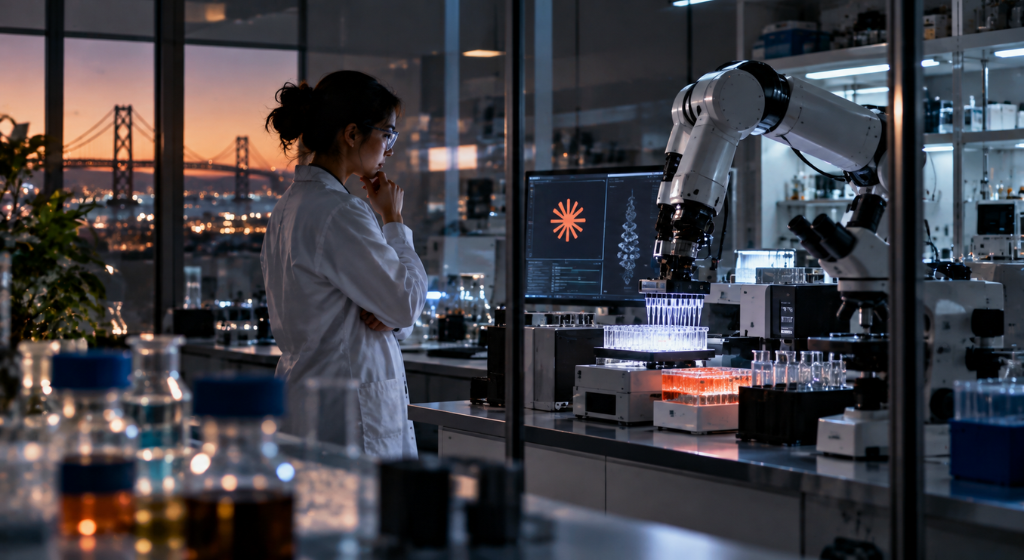
Anthropic is bringing Claude into a Bay Area wet lab to connect AI reasoning with physical biology experiments as it works toward more automated scientific research. (Source: Image by RR)
Physical Experiments Could Help AI Test Biological Hypotheses in Real Time
Anthropic has established a wet biology lab in the San Francisco Bay Area where its AI models can participate in physical scientific experiments, pushing Claude beyond computer-based research and into the laboratory. Anthropic’s head of life sciences, Eric Kauderer-Abrams, confirmed the facility and said real-world experiments remain essential for validating biological ideas generated or analyzed by AI. The company says the lab’s primary focus is fundamental biology rather than developing its own drugs, an important distinction as Anthropic simultaneously expands partnerships with pharmaceutical and biotechnology companies.
The facility fits into Anthropic’s broader effort to connect AI agents with physical scientific equipment. Its Model Hardware Standard is designed to provide a common interface through which AI systems can operate devices including microscopes, liquid handlers and robotic arms, allowing an agent to coordinate multiple instruments, monitor results and adjust experimental parameters as conditions change. Anthropic, as noted in an article in techcrunch.com, says the longer-term objective is enabling more autonomous, closed-loop experiments in which scientists define the biological goal while AI helps execute and analyze the physical workflow.
Anthropic has already been expanding aggressively into scientific research. The company acquired AI biotech startup Coefficient Bio in April, recently introduced Claude Science as an AI workbench for researchers and launched a Life Sciences Verification Program that gives vetted biology professionals access to its most powerful models under specialized safeguards. Anthropic has also published research involving protein design and biomolecular modeling, while working with outside organizations on drug discovery and other life-science applications.
The move into physical biology also highlights the tension surrounding increasingly capable AI systems. Anthropic has repeatedly warned that advanced models could create biological misuse risks even as it develops technology intended to accelerate legitimate scientific discovery. Its current hardware program still requires expert oversight: Anthropic acknowledges that Claude’s understanding of physical systems remains limited and that researchers have needed to intervene when laboratory problems involved real-world physics the model did not understand. The wet lab therefore represents both a significant expansion of AI-assisted science and a real-world test of how safely AI can move from recommending experiments to helping perform them.
read more at techcrunch.com







Leave A Comment