

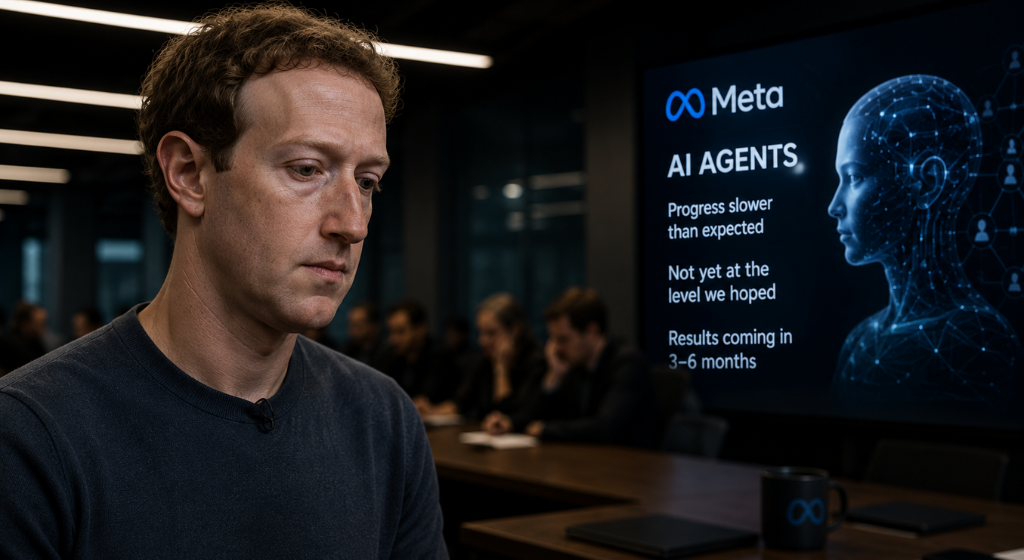
Meta’s latest assessment suggests that while AI agents remain central to the future of enterprise software, turning ambitious concepts into reliable, large-scale business tools is proving more difficult—and more time-consuming—than many expected. (Source: Image by RR)
Meta CEO Reports Slower Progress on Enterprise AI Agent Development
Mark Zuckerberg reportedly told employees that the development of AI agents has progressed more slowly than Meta originally anticipated, signaling that one of the industry’s most ambitious AI initiatives has yet to deliver its expected impact. During an internal town hall, Zuckerberg acknowledged that despite major organizational changes and billions of dollars in AI investment, the company’s AI-focused restructuring has not yet produced the acceleration executives had hoped to achieve.
Earlier this year, Meta laid off approximately 8,000 employees while reassigning thousands more into dedicated AI divisions, including a team focused on AI agents. Zuckerberg, according to an article in techcrunch.com, reportedly admitted that the restructuring process was less efficient than intended, explaining that leadership believed rapid organizational changes were necessary to remain competitive as the AI race intensified. However, he also noted that many of the expected gains have yet to fully materialize.
Despite the slower-than-expected progress, Zuckerberg remains optimistic that Meta’s investments will begin generating measurable improvements within the next three to six months. The company continues to commit enormous resources toward AI development, with planned infrastructure spending reportedly reaching approximately $145 billion this year. The comments suggest that Meta remains confident in its long-term AI strategy while acknowledging that building practical AI agents has proven more technically challenging than early expectations suggested.
The remarks offer a rare glimpse into the realities facing frontier AI development. While public discussions often portray AI agents as an imminent workforce revolution, Meta’s experience highlights the complexity of moving from impressive demonstrations to dependable enterprise-scale systems. As AI companies continue investing unprecedented sums into infrastructure and research, the timeline for widespread deployment may prove more gradual than many early projections implied.
read more at techcrunch.com










Leave A Comment