

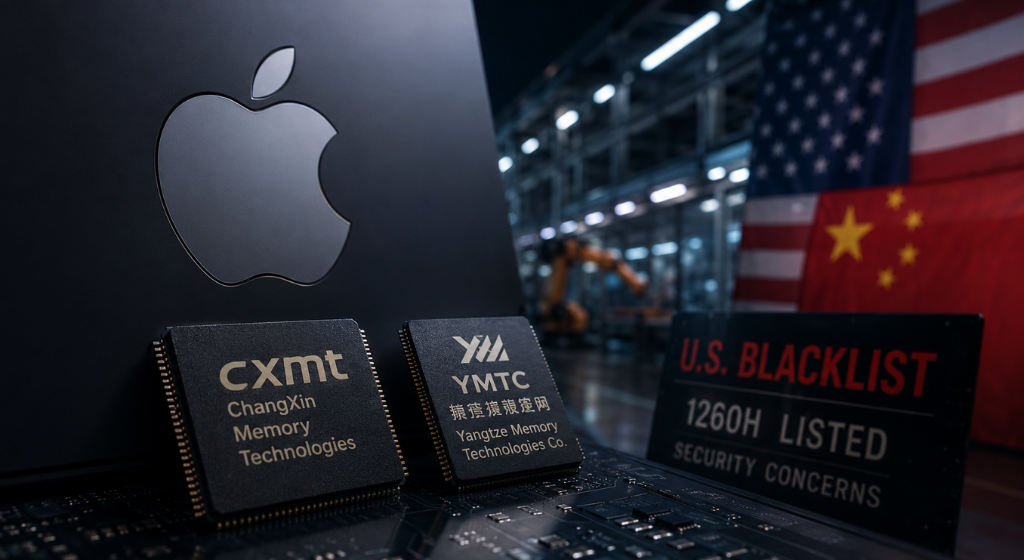
Apple’s reported sourcing discussions highlight how the rapid expansion of AI infrastructure is transforming the global semiconductor market, forcing technology companies to navigate an increasingly complex intersection of cost, supply chain resilience, and geopolitical risk. (Source: Image by RR)
AI Infrastructure Growth Continues Reshaping Global Semiconductor Markets
Apple is reportedly exploring agreements to purchase memory chips from Chinese manufacturers currently listed on U.S. government blacklists as the company seeks relief from a global semiconductor shortage driven largely by artificial intelligence demand. According to reports, the discussions involve sourcing DRAM and NAND memory from ChangXin Memory Technologies (CXMT) and Yangtze Memory Technologies (YMTC) for devices sold exclusively within the Chinese market, allowing Apple to diversify its supply chain while limiting geopolitical exposure.
The move, as noted in zerohedge.com, follows sharp increases in memory prices across the technology industry. As hyperscale AI data centers consume unprecedented amounts of high-performance memory for AI training and inference, manufacturers have increasingly prioritized enterprise products over consumer electronics. The resulting supply imbalance has contributed to higher component costs for smartphones, tablets, and personal computers, forcing Apple and other hardware manufacturers to raise prices while searching for alternative suppliers.
Any agreement would likely face significant political scrutiny. Both CXMT and YMTC have been linked to U.S. national security concerns, with YMTC appearing on the Commerce Department’s Entity List and both companies identified by the Pentagon as having ties to China’s military-industrial ecosystem. Although Apple would not necessarily require formal government approval for China-only sourcing, the arrangement could intensify ongoing debates surrounding technology supply chains, export controls, and economic competition between the United States and China.
Beyond Apple’s immediate procurement strategy, the situation illustrates how artificial intelligence is reshaping the global semiconductor industry. Memory chips, once viewed as commodity components, have become increasingly strategic assets as AI infrastructure expands worldwide. The episode underscores how rising AI demand is influencing manufacturing priorities, supply chain decisions, pricing, and geopolitical relationships across the broader technology sector.
read more at zerohedge.com











Leave A Comment