


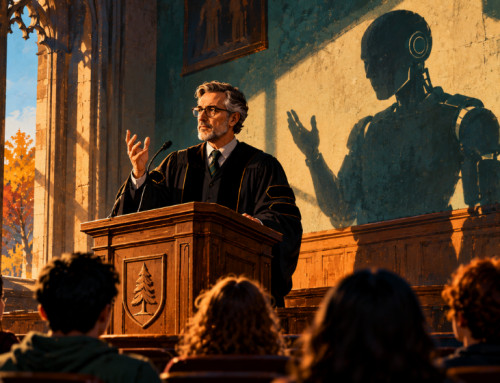
A University of Kentucky administrator secured a workplace accommodation allowing him to avoid personally using AI tools because of his humanist beliefs, raising questions about employee choice as workplace AI adoption expands. (Source: Image by RR)
Workplace AI Adoption Creates New Questions about Religious Protections
A University of Kentucky administrator has secured a workplace accommodation allowing him to abstain from personally using artificial intelligence tools because of his sincerely held humanist beliefs. David Durman, a nontheistic humanist who supports researchers applying for grants, pursued the accommodation with assistance from the American Humanist Association, arguing that reliance on AI conflicts with his ethical convictions about human reasoning, creativity and personal responsibility. The decision illustrates how objections to workplace AI can extend beyond traditional religious communities and raises new questions about employee rights as artificial intelligence becomes increasingly integrated into professional responsibilities.
Durman, as noted in a story in techcrunch.com, argues that humanism places significant value on the active exercise of human judgment and the development of intellectual and moral capabilities. He believes that excessive reliance on AI could undermine those qualities while contributing to broader concerns involving employment, environmental costs and creative work. Although he has not been required to use AI in his current position, recommendations from colleagues and university leadership to experiment with the technology prompted him to seek formal protection in case its use becomes mandatory. The American Humanist Association supported his request, emphasizing that qualifying religious protections can extend to sincerely held nontheistic belief systems rather than requiring belief in a deity.
The University of Kentucky confirmed that it evaluates religious accommodation requests individually, considering employees’ responsibilities and whether the requested adjustments allow them to perform essential job functions. In Durman’s case, the university determined that he could continue fulfilling his duties without personally using AI tools. The institution also indicated that accommodations may be reconsidered as technology and job requirements evolve. A similar accommodation was previously obtained by software engineer Erin Maus, a Unitarian Universalist, demonstrating that concerns about mandatory AI use can arise across different occupations and belief traditions.
The case highlights a developing workplace challenge as companies increasingly encourage or require employees to incorporate AI into everyday tasks. While employers may view AI as a tool for improving efficiency and productivity, some workers object to its use on ethical, philosophical or religious grounds. Durman’s accommodation does not establish a universal right to refuse AI, and the legal outcome of future disputes will depend on individual circumstances and applicable employment protections. Nevertheless, the decision introduces a new dimension to discussions about workplace automation: how organizations can promote technological adoption while respecting employees whose sincerely held beliefs conflict with particular tools.
read more at techcrunch.com










Leave A Comment