

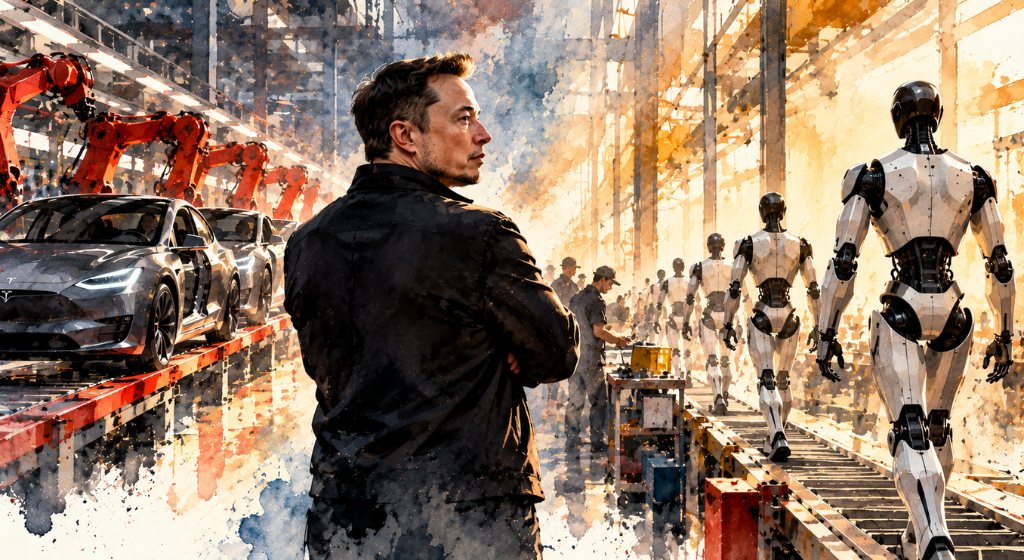
Tesla has begun early production of its Optimus humanoid robot as rising AI and robotics investment coincides with a 43 percent decline in quarterly profits. (Source: Image by RR)
Optimus Production Marks Shift toward AI-Driven Physical Automation
Tesla has begun early production of its Optimus humanoid robot at its Fremont, California, factory, marking a significant step in the company’s effort to expand beyond electric vehicles into robotics and artificial intelligence. The production line occupies manufacturing space previously used for automobiles, reflecting Tesla’s growing emphasis on developing machines capable of performing physical tasks. In its third-quarter shareholder update, Tesla described the first units as production-quality robots and said its manufacturing process had reached a stage suitable for a commercial product. CEO Elon Musk cautioned that production would increase gradually as engineers continue refining the hardware, reliability and artificial intelligence needed for more complex applications.
The announcement, as noted in an article in techcrunch.com, comes as Tesla reported a sharp decline in third-quarter profitability. Net income fell 43 percent year over year to $787 million, compared with $1.37 billion during the same period in 2025. Total revenue was nearly unchanged at $28.04 billion, while automotive revenue remained approximately $20 billion. Tesla delivered 486,532 vehicles during the quarter, slightly more than in the preceding three months but fewer than a year earlier. Higher spending on AI development, robotics and autonomous driving contributed to the pressure on earnings, alongside lower regulatory credit sales and weaker revenue from the company’s energy business.
Despite those financial challenges, Musk outlined ambitious plans for Optimus manufacturing. He said Tesla could eventually produce 20,000 robots per week by the end of 2027, although he acknowledged that the company still needs to improve the robot’s durability, safety and ability to complete open-ended tasks. The target would represent a dramatic increase from current early-stage production and remains dependent on further engineering advances. Tesla’s growing investment in robotics reflects its belief that humanoid machines could become an important future business, even as their commercial applications, pricing and production economics remain largely unproven.
Tesla also reiterated its commitment to autonomous driving, although the rollout of unsupervised capabilities has again moved beyond earlier expectations. Company executives now anticipate that some privately owned Tesla vehicles could begin participating in a robotaxi network around the second quarter of 2027, subject to further development. The company’s current Full Self-Driving software still requires active driver supervision. Together, the Optimus production announcement and autonomous-driving plans highlight Tesla’s increasingly technology-centered strategy, with management pursuing long-term opportunities in robotics and AI while its established automotive operations continue to provide the bulk of its revenue.
read more at techcrunch.com


Leave A Comment