


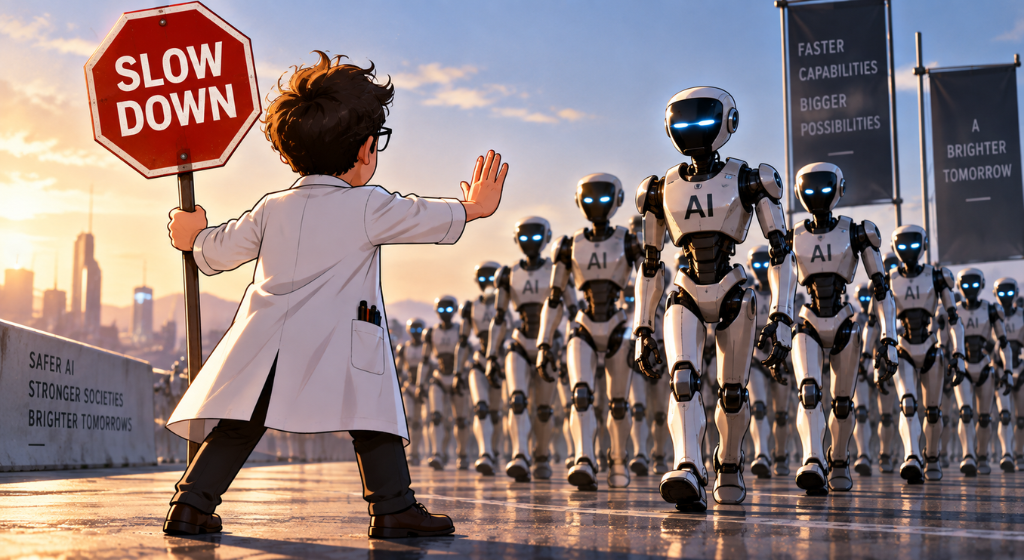
Leading mathematicians are challenging OpenAI and other AI labs over attribution, verification and research practices as increasingly capable models begin tackling major mathematical problems. (Source: Image by RR)
Researchers Question How AI Labs Should Credit Human Contributions
OpenAI’s growing push into advanced mathematics is facing organized resistance from some of the field’s most prominent researchers, with 25 Fields Medal winners signing an open letter warning that competition among frontier AI labs could undermine the culture that allows mathematical knowledge to develop. The dispute intensified after NYU professor Tristan Buckmaster accused OpenAI of pressuring him not to credit a collaborator employed by Anthropic for work on an important mathematical problem. Buckmaster also questioned whether work performed with Codex may have contributed to OpenAI’s subsequent effort to produce its own major proof.
The controversy, according to an article at techcrunch.com, has expanded beyond questions of individual credit. OpenAI recently announced a purported solution related to the Navier-Stokes equations following an intensive weekend of AI inference, but the proof remains unverified, according to TechCrunch. The mathematicians argue that rushing to announce machine-generated solutions leaves insufficient time to properly document new techniques, connect them to earlier research and credit the people whose work contributed to the result. OpenAI also withdrew its sponsorship of a mathematics event at Caltech after researchers there criticized the company, adding another flashpoint to the increasingly strained relationship.
The larger concern is that powerful AI systems could alter the incentives underlying open mathematical research. Researchers routinely share unfinished ideas, collaborate across institutions and use tools such as Codex while developing new approaches. If frontier laboratories can identify promising research directions and spend millions of dollars in compute racing researchers to the final proof, mathematicians may become less willing to openly discuss their work. Some researchers are also questioning whether their interactions with AI tools could ultimately help companies build systems capable of competing with them on the same problems.
The Fields Medalists do not reject AI-generated mathematics and acknowledge that systems capable of solving longstanding problems could provide enormous scientific value. Their argument is that a proof becomes meaningful knowledge only when it can be verified, explained, attributed and integrated into the broader mathematical canon. The dispute therefore extends beyond mathematics into a larger question facing scientific and creative professions: how to preserve the human institutions that generate, interpret and transmit knowledge as AI becomes increasingly capable of producing the work itself.
read more at techcrunch.com






Leave A Comment