


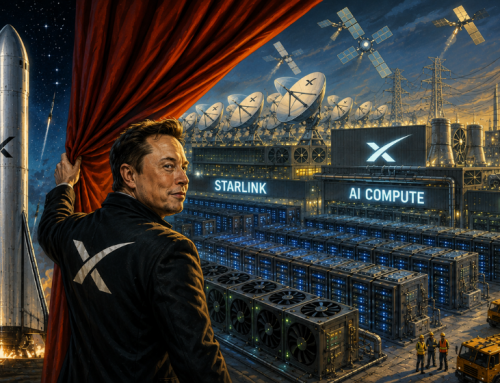
Jensen Huang’s vision for the AI era suggests that the greatest challenge may not be developing more advanced systems, but building the social, economic, and infrastructure frameworks needed for society to adapt successfully to their growing influence. (Source: Image by RR)
Comparisons to the Automobile Era Highlight Need for Societal Adaptation
In a wide-ranging interview, Jensen Huang argued that society must develop new social norms and institutions to adapt to the rapid advancement of artificial intelligence. Rather than viewing AI as a threat to be resisted, Huang encouraged broader public engagement with the technology, suggesting that AI has the potential to improve productivity, expand opportunity and drive scientific and economic progress if embraced responsibly.
Huang, as noted in an article at apnews.com, compared the current AI transition to earlier societal adaptations to transformative technologies such as automobiles. Just as communities developed sidewalks, traffic laws and safety standards to accommodate cars, he believes AI will require new norms, policies and expectations that allow society to safely integrate increasingly powerful systems into everyday life. While acknowledging legitimate concerns about labor disruption and technological change, he emphasized that adaptation rather than avoidance is the more productive path forward.
The Nvidia chief also addressed growing debates around AI regulation, national security, and economic inequality. He expressed support for targeted government oversight and safety standards while cautioning that policies should be carefully designed around specific risks. Huang additionally questioned proposals involving direct government ownership of AI companies, arguing that the benefits of successful technology firms already flow through taxes, jobs, investment returns, and broader economic activity.
A recurring theme throughout the interview was infrastructure. Huang argued that energy production has become one of the most significant constraints on AI development, warning that the United States must dramatically expand its power generation capacity to remain competitive. In his view, the future of AI leadership will depend not only on models and chips, but also on the ability to supply the electricity, manufacturing capacity, and industrial ecosystem necessary to support large-scale AI deployment.
read more at apnews.com










Leave A Comment