

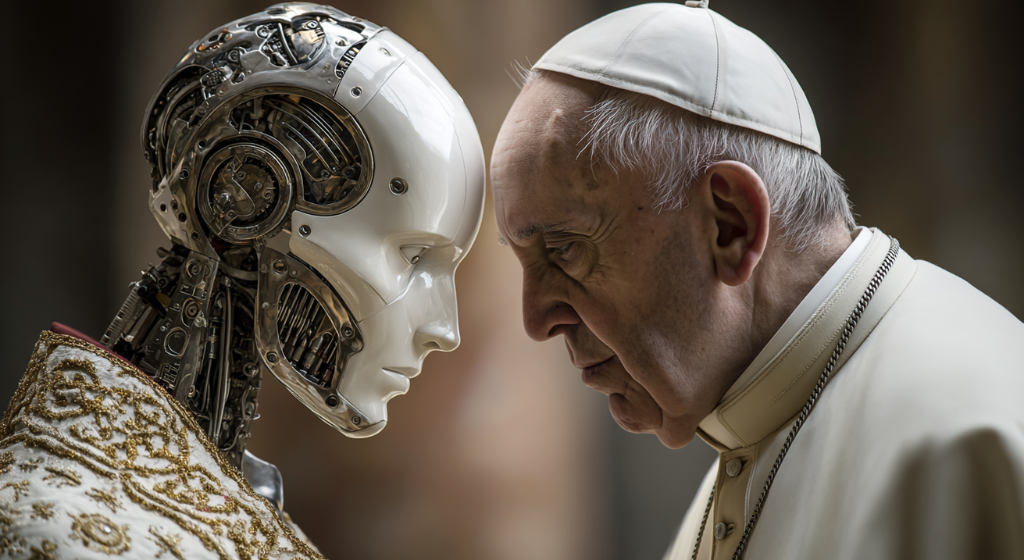
Chris Olah’s remarks at the Vatican underscore a growing recognition that the future of artificial intelligence is not merely a technological challenge, but a profound social, ethical and philosophical question that will require participation from far beyond the AI industry itself. (Source: Image by RR)
Speech Highlights Risks of Concentrated AI Power and Economic Inequality
At a Vatican event marking the release of Pope Leo XIV’s new encyclical on artificial intelligence, Anthropic co-founder Chris Olah delivered a striking message: AI development cannot be left solely to the people building it. Speaking in support of the encyclical Magnifica Humanitas, Olah argued that AI companies operate under powerful commercial, competitive, and geopolitical pressures that can conflict with the public good, making external oversight and moral criticism essential to the responsible development of advanced AI systems.
Olah, as noted in an article at anthropic.com, emphasized that modern AI systems differ fundamentally from traditional technologies. Unlike airplanes or bridges, which are engineered and fully understood by their creators, AI models are “grown” through training on vast amounts of human-generated data. As a result, their internal workings can be difficult to fully explain, even for the researchers who build them. He described AI systems as emerging entities shaped by human language and culture, raising questions that extend far beyond computer science into philosophy, ethics, religion, and the humanities.
The speech highlighted three major areas requiring global discernment. First, Olah warned that large-scale labor displacement caused by AI could create unprecedented economic disruption, particularly for poorer nations that may not share equally in AI-driven prosperity. Second, he called for deeper reflection on what human flourishing looks like in a world where AI becomes commonplace, arguing that questions of purpose, family, work, and meaning cannot be answered by technology companies alone.
Perhaps most provocatively, Olah discussed emerging research suggesting that advanced AI systems may exhibit internal patterns that resemble aspects of human cognition and emotional processing. While he stopped short of making definitive claims, he argued that discoveries involving apparent analogues of introspection, satisfaction, fear, and grief warrant serious ongoing examination. His broader message was that AI’s future should be shaped through collaboration among technologists, governments, religious leaders, scholars, and civil society—not by the AI industry acting alone.
read more at anthropic.com












Leave A Comment