

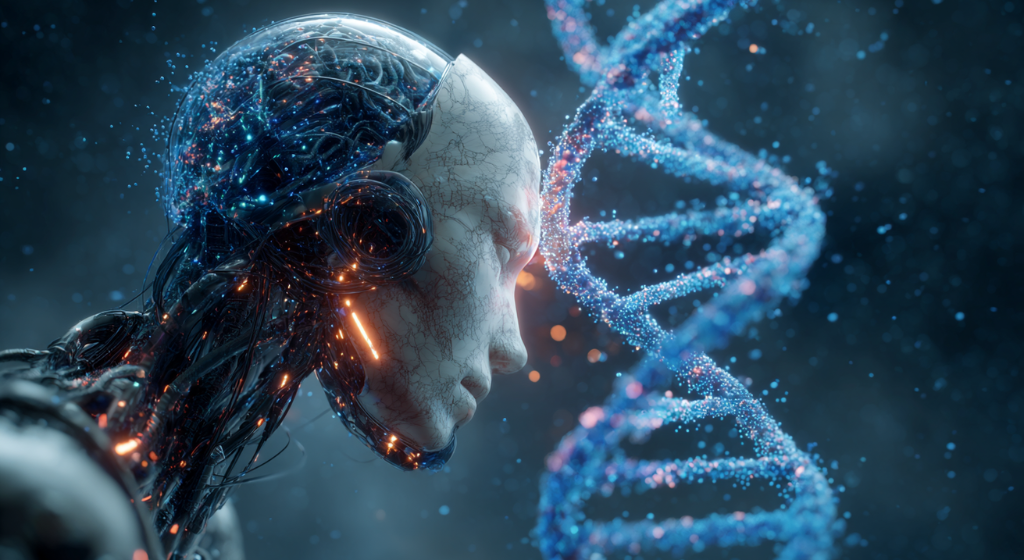
By combining massive DNA libraries with machine learning, Rice University scientists have created a powerful new way to predict how genetic circuits behave—dramatically speeding progress in synthetic biology and therapeutic design. (Source: Image by RR)
Rice University Researchers Combine AI with Massive DNA Libraries
Researchers at Rice University have unveiled a powerful new approach that could significantly accelerate how DNA is designed for biotechnology and therapeutic applications. One of synthetic biology’s biggest challenges has been identifying which DNA sequences will reliably produce specific cellular behaviors, a process often described as searching for a needle in a haystack. By pairing artificial intelligence with massive genetic libraries, the Rice team has found a way to dramatically scale and streamline this search.
The new method, called CLASSIC—short for combining long and short range sequencing to investigate genetic complexity—allows scientists to generate and test hundreds of thousands to millions of genetic circuit designs simultaneously. Genetic circuits, as noted in interestingengineering.com, are DNA sequences programmed to control cellular behavior, and mapping them to real-world outcomes has traditionally been slow and limited in scope. CLASSIC overcomes that bottleneck by enabling researchers to observe how vast numbers of designs perform inside living human cells.
A key innovation lies in combining long-read and short-read DNA sequencing. Long-read sequencing captures entire genetic circuits, while short-read sequencing efficiently identifies barcodes that track individual designs. The researchers inserted these circuits into human embryonic kidney cells engineered to glow when specific genes were activated, allowing performance to be measured visually and at scale. The resulting data links precise DNA sequences to measurable cellular behavior.
With this large, high-quality dataset, the team trained machine learning models capable of accurately predicting how untested genetic designs would perform. In early validation tests, the AI’s predictions matched experimental results perfectly across dozens of sequences. The findings suggest that many functional genetic solutions exist for a given task, opening the door to more flexible and robust biological designs. Published in Nature, the work highlights how AI-driven design could speed the development of cell therapies, engineered tissues and next-generation synthetic biology tools.
read more at interestingengineering.com












Leave A Comment