

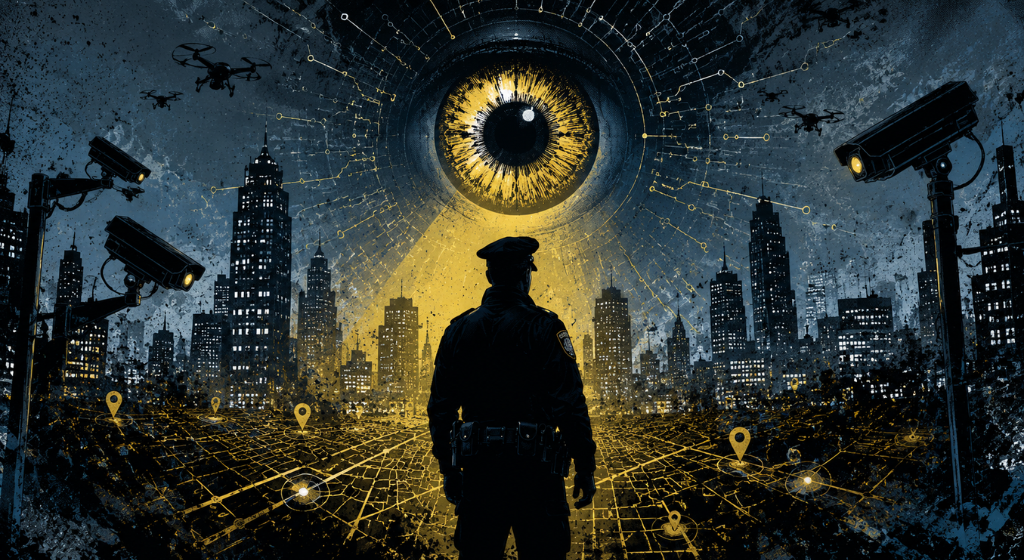
The growing adoption of artificial intelligence in policing signals a fundamental shift in public safety, where the challenge is no longer whether AI can assist law enforcement, but how to ensure its use remains transparent, accountable and consistent with the principles of justice. (Source: Image by RR)
Experts Raise Questions about Transparency and Algorithmic Accountability
Artificial intelligence is rapidly becoming embedded throughout American law enforcement, as technology companies race to supply police departments with AI-powered report writing, surveillance systems, dispatch tools, facial recognition, drones, automated license plate readers and real-time crime analysis platforms. Vendors argue these technologies reduce administrative burdens and help officers make faster, more informed decisions by processing enormous volumes of public safety data.
Much of the industry’s current focus centers on AI-assisted decision support rather than fully autonomous policing. Companies such as Axon Enterprise, Motorola Solutions and numerous startups are promoting AI systems capable of organizing incident data, drafting police reports, summarizing case histories, and helping dispatch resources in real time. Proponents, according to an article in theverge.com, argue these systems improve efficiency and situational awareness, while critics caution that many claims remain difficult to independently verify because of limited transparency surrounding proprietary AI models.
Legal scholars, civil rights advocates, and some law enforcement officials warn that introducing increasingly sophisticated AI into policing could amplify longstanding concerns surrounding bias, accountability, and due process. Earlier generations of predictive policing systems demonstrated how historical data can reinforce existing disparities, and experts caution that modern AI systems may inherit many of the same challenges if training data, model behavior, and decision-making processes remain opaque. The use of generative AI to draft official police reports has also raised questions about evidentiary reliability and courtroom transparency.
The debate reflects a broader transformation in public safety technology. As AI becomes integrated into every stage of policing—from collecting evidence to allocating officers and documenting investigations—the conversation is shifting beyond technological capability toward democratic oversight. The decisions police agencies make today regarding AI procurement, governance, and transparency may ultimately shape how public trust, accountability, and justice evolve alongside increasingly automated law enforcement systems.
read more at theverge.com











Leave A Comment