

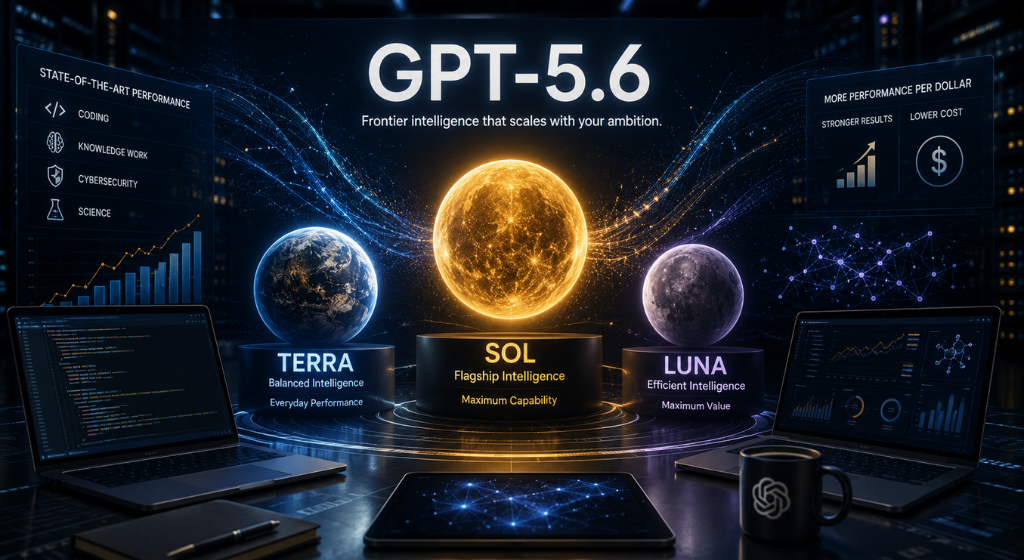
GPT-5.6 represents OpenAI’s shift toward maximizing intelligence per unit of compute, combining stronger reasoning, lower operating costs, and broader enterprise capabilities while reinforcing the company’s long-term strategy of building an integrated AI platform from infrastructure to applications. (Source: Image by RR)
Coding, Science, Knowledge Work Receive Significant Performance Gains
OpenAI has officially launched the GPT-5.6 family of models, introducing three new tiers—Sol, Terra, and Luna—designed to deliver stronger performance, improved efficiency, and lower operating costs across coding, enterprise knowledge work, cybersecurity, and scientific research. The flagship Sol model emphasizes greater intelligence per token, while Terra and Luna provide lower-cost alternatives intended to expand access to advanced AI capabilities across a broader range of users and applications.
A defining feature of GPT-5.6 is its focus on efficiency rather than simply scaling model size. OpenAI reports that the new models complete many professional tasks using fewer tokens, less latency, and lower overall cost than previous generations, while also introducing “Ultra” mode—a multi-agent reasoning system capable of coordinating parallel AI agents on particularly demanding workflows. The company, as noted in an article at openai.com, says this architecture significantly improves performance in software engineering, research, document creation, and long-running enterprise tasks.
Beyond productivity improvements, GPT-5.6 demonstrates notable gains in cybersecurity and scientific reasoning. OpenAI reports higher benchmark performance in secure code review, vulnerability analysis, life sciences, chemistry, and complex research workflows while introducing its most comprehensive safety system to date. Rather than relying solely on static content filters, GPT-5.6 combines reasoning-based safeguards, continuous monitoring, layered enforcement, and expanded verification programs for high-risk cybersecurity use cases.
The launch also reflects OpenAI’s broader strategic evolution into a full-stack AI platform. Alongside advances in reasoning, coding, and knowledge work, the company highlighted growing internal use of AI to accelerate its own research and engineering processes. Combined with recent investments in custom silicon, infrastructure, and enterprise tooling, GPT-5.6 represents another step toward OpenAI’s long-term vision of making advanced intelligence faster, more affordable, and increasingly embedded across both business and everyday computing.
read more at openai.com











Leave A Comment