


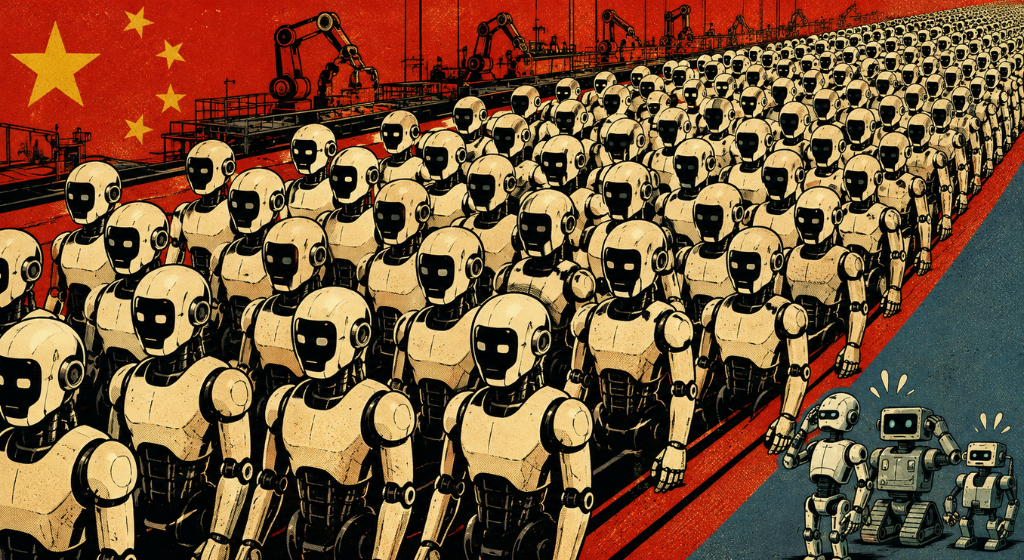
The U.S.–China AI rivalry is less a single race than a clash of philosophies, with America chasing speculative dominance while China prioritizes practical deployment, governance, and economic integration—raising urgent questions about which path leads to stability rather than conflict. (Source: Image by RR)
American Tech Leaders Frame AI as a High-Stakes Existential Race
In the United States, artificial intelligence is increasingly framed as an existential race against China—one in which achieving superintelligent systems is portrayed as both inevitable and necessary for global dominance. This narrative, promoted by major U.S. tech firms and echoed by political leaders, treats AI as a winner-take-all contest regardless of economic, social, or environmental cost. According to an article at blog.ucs.org, the underlying assumption is that failing to “win” the AI race would threaten national survival.
By contrast, Chinese AI development is following a markedly different trajectory. According to insights shared at the East Asia Quadrilateral Dialogue in Tokyo, hundreds of small and mid-sized Chinese firms are focused on building embodied and applied AI systems, particularly in areas like robotics and manufacturing. These efforts aim to deliver immediate economic and social benefits rather than chasing speculative milestones like artificial general intelligence (AGI). While China’s largest firms do explore AGI, it is not the central driver of national policy or investment decisions.
The structural differences are stark. In the U.S., AI power and capital are concentrated among a handful of corporations whose leaders often frame AI in apocalyptic terms—some even preparing personal contingency plans for a post-collapse world. In China, AI development is tightly intertwined with state governance, where the Communist Party views AI as one tool among many for managing society. Chinese policymakers appear more concerned with social stability, regulation, and economic integration than with abstract technological dominance.
The article argues that Washington’s fixation on competition has undermined opportunities for cooperation and risk management. Decades of U.S. efforts to restrict China’s technological growth—from sanctions to export controls—have failed to slow progress and may have accelerated Chinese self-reliance. Drawing lessons from post–World War II international institutions, the author contends that escalating AI rivalry increases the risk of conflict. Forums like the East Asia Quadrilateral Dialogue suggest an alternative path: rebuilding trust, establishing shared governance norms, and treating AI as a domain for managed cooperation rather than unrestrained competition.
read more at blog.ucs.org










Leave A Comment