


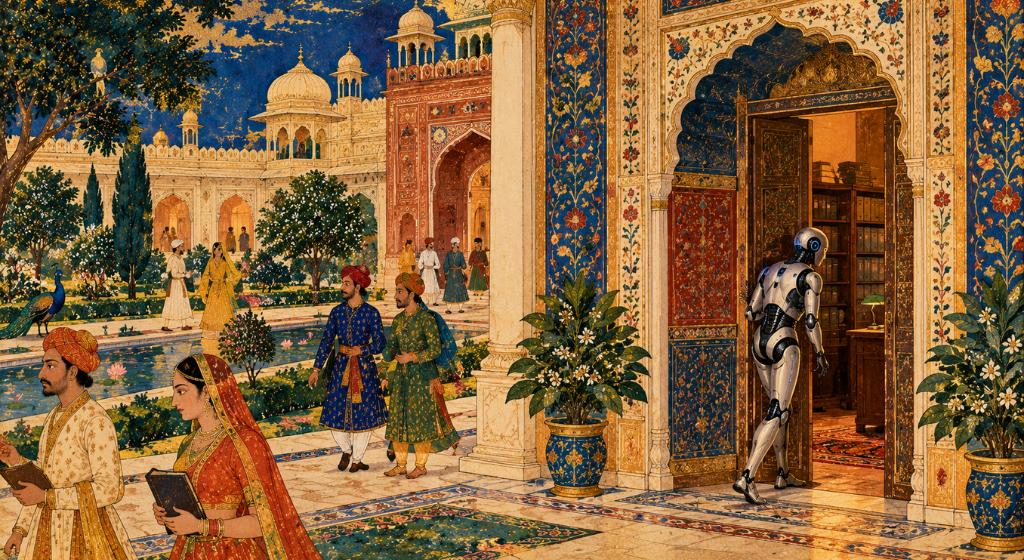
Marble, a multimodal AI world model, is now publicly available, enabling users to generate, edit, and expand lifelike 3D worlds from text, images, or video—ushering in a new era of spatial intelligence and creative freedom across industries. (Source: Image by RR)
Fei-Fei Li’s Vision of Spatial Intelligence Shines in Marble’s Multimodal World Model
Marble has officially launched as a next-generation generative multimodal world model, marking a major leap toward spatial intelligence—the ability of AI to perceive, construct, and simulate 3D environments. First introduced in preview form two months ago, Marble can now generate fully traversable 3D worlds from text, image, video, or even rough 3D layouts. Users can edit, expand, and export these worlds as Gaussian splats, meshes, or videos. The launch also includes Marble Labs, a collaborative space for artists, engineers, and designers to experiment with world-building and explore creative and industrial applications.
At its core, Marble mimics the way humans synthesize sensory information to understand their surroundings, integrating multimodal data into cohesive 3D simulations. It represents, as noted at worldlabs.ai, a significant step toward world models that can dynamically reconstruct reality and reason spatially. With Marble, users can transform simple prompts into detailed virtual spaces, from whimsical libraries to photorealistic landscapes. The system’s multi-image and video inputs also enable higher creative precision, allowing users to stitch perspectives together into unified digital worlds with seamless transitions.
A standout innovation is Marble’s Chisel mode, which allows direct 3D sculpting of environments using basic geometric forms or imported assets. This decouples structure from style—users can design a rough layout, then apply text prompts to stylize the scene into a museum, home, or fantasy world. The software also includes advanced editing tools for fine-tuning details, adding realism, or completely redesigning existing environments. Users can expand generated worlds infinitely or compose multiple environments together, producing massive interconnected spaces for gaming, robotics, or simulation.
Beyond creative design, Marble’s implications stretch into industries like virtual production, architecture, and robotics. By enabling rapid creation and manipulation of realistic virtual spaces, it could redefine workflows in simulation, training, and entertainment. Marble’s creators describe it as only the beginning—a foundation for future “spatially intelligent” systems capable of interactive reasoning. As AI continues to evolve from language to space, Marble positions itself at the frontier of a new era in 3D generative intelligence.
read more at worldlabs.ai








Leave A Comment