

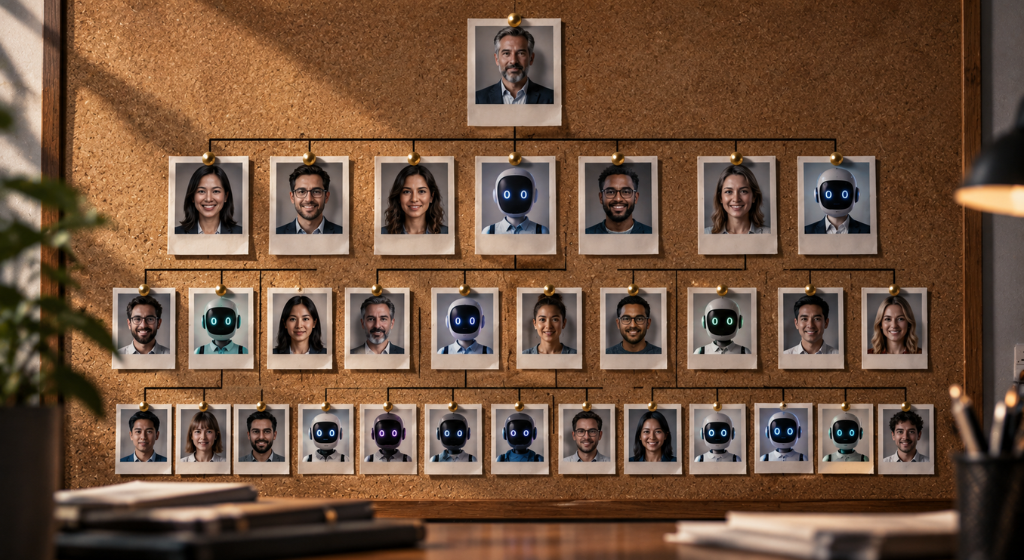
AI agents are moving from workplace tools to digital coworkers with names, roles and autonomous responsibilities, forcing companies to rethink trust, oversight and how humans interact with artificial colleagues. (Source: Image by RR)
Workplace Agents Move Beyond Tools toward Autonomous Employee Roles
AI agents are beginning to move beyond workplace tools and take on roles that increasingly resemble actual employees, appearing in company org charts, communication channels and day-to-day workflows. Unlike earlier workplace AI products designed primarily to assist individual employees, newer agents are built to complete tasks autonomously and remain active when human colleagues are offline. A Boston Consulting Group survey of 1,261 managers conducted in January found that 22 percent said their organizations had already added AI agents to corporate org charts, suggesting companies are beginning to treat software agents as members of the workforce rather than simply another application.
Companies developing these systems are intentionally making them easier to perceive as coworkers. Anything’s Skydive platform gives agents individual names, roles, cloud computers and Muppet-like avatars while allowing them to operate across Slack, email and iMessage. At Pronto Housing, agents handle work including contracts, scheduling and customer follow-ups, while a coding agent became integrated enough with the engineering team that employees began describing projects as work they completed “with Alice.” The agents, according to an article in wired.com, also adapt to employees’ communication styles and corrections over time, reinforcing the sense that workers are collaborating with a persistent colleague rather than issuing commands to a conventional software tool.
That human-like framing can influence how workers evaluate AI output. Research from BCG found that managers caught 18 percent fewer errors when they were told work had been produced by an “AI employee” rather than an “AI tool.” The finding raises questions about whether anthropomorphizing workplace agents could encourage employees to extend human-like trust to systems that still possess distinctly nonhuman weaknesses. Companies are only beginning to determine what workplace guardrails should apply when an AI can simultaneously resemble an employee, function as software and operate autonomously across business systems.
The arrival of AI coworkers also introduces broader questions about workplace behavior and relationships. Employees may communicate differently with agents because they know no human feelings are involved, while increasingly personable avatars and conversational interfaces encourage people to form attachments to them. Lattice CEO Sarah Franklin argues that companies should use digital employees to create accountability rather than encourage workers to treat AI systems as human colleagues, warning that emotional attachment can become a product strategy rather than a workplace benefit. As AI agents become more capable and widespread, businesses will have to establish not only what work these systems should perform, but what kind of relationship human employees should have with them.
read more at wired.com



Leave A Comment